Maximizing a Probability Function
Extracted from the book "Exploring Mathmematics with Scientific Notebook",
Published by Springer Verlag, ISBN #981-3083-88-3, by me and Professor
Jonathan Lewin of Kennesaw State University, Georgia.
In this example, we suppose that we have

 white balls and
 black balls which we are going to place in two urns A and B in any way we
please, as long as at least one ball is placed into each urn. After this has
been done, a second person walks into the room and selects one ball at random.
Our problem is to maximize the probability that this person draws a white
ball.
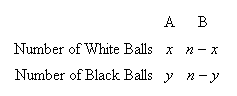
We suppose that the distribution of the balls in the urns A and B is as
described in the following table:
If
 is the probability that a single ball drawn at random will be white then

From now on we shall assume that
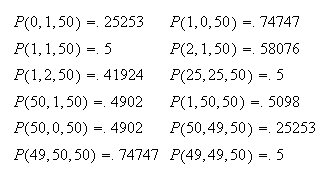
 We begin our study of the function by looking at the following table which
shows the values of
 at a few selected points

To solve the problem we need to find the maximum value of the expression
 as the point
 varies through the rectangle
 from which the points
 and
 have been removed. If we sketch the graph
 then we obtain the following surface:
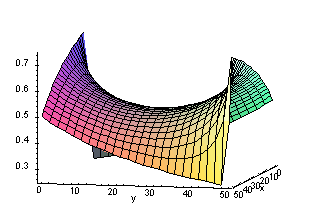
From the looks of this surface it seems unlikely that the maximum value of
 will be achieved at a critical point. The maximum appears to be at the left or
right extremities of the figure. As a matter of fact, if we point at the
equations
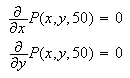
and click on Solve and Exact
then we obtain
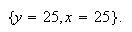
As we have already seen, the maximum value of
 does not occur at the point

We now examine the boundary behavior of the function. There are four cases to
consider
The Case
 and

We define
 for
 Point at this definition of
 and click on Define and New
Definition. Since
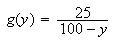
for each
 we see that the maximum value of
 is

The Case
 and

We define
 for
 Point at this definition of
 and click on Define and New
Definition. Since

for each
 we see that the maximum value of this function is

The Case
 and

We define
 for
 Point at this definition of
 and click on Define and New
Definition. Since
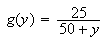
for each
 we see that the maximum value of this function is

The Case
 and

We define
 for
 Point at this definition of
 and click on Define and New
Definition. Since
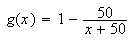
for each
 we see that the maximum value of this function is

Conclusion
We conclude that the expression
 takes a maximum value of
 at the point
 and again at the point
 This means that we can maximize the probability that a white ball will be
selected by placing one white ball and no black ball in urn A and all the
other balls in urn B. Alternatively we can place one white ball and just no
black ball in urn B and all the other balls in urn A.
This document created by Scientific WorkPlace 4.0.